Antarctica Files
The Antarctic Treaty, 1959: The Continent No One Owns
The first great Cold War arms-control agreement was not about missiles. It was about an ice sheet. In 1959, twelve nations agreed that no one would own Antarctica and that no one would fortify it.

Case summary
- Date
- 1955–1961
- Location
- Antarctica
- Case file no.
- 1959-ATS
- Category
- Antarctica Files
- Official finding / status
- Antarctica is reserved for peaceful purposes. Military measures, weapons tests and nuclear explosions are banned. Inspections are permitted.
Operation Deep Freeze
After Operation Highjump, the United States returned to Antarctica in force for the International Geophysical Year of 1957–58. Operation Deep Freeze, which began in 1955–56, established McMurdo Station and built the Amundsen–Scott South Pole Station, dedicated in January 1957. U.S. Navy Seabees built the bases, and the Navy supported them with ships and aircraft.
Other nations, including the Soviet Union, the United Kingdom, Argentina, Chile and Australia, built stations of their own, and several claimed overlapping territory.
The treaty
The Antarctic Treaty was signed in Washington, D.C. on December 1, 1959, by twelve countries: Argentina, Australia, Belgium, Chile, France, Japan, New Zealand, Norway, South Africa, the Soviet Union, the United Kingdom and the United States. It entered into force on June 23, 1961.
Its core rules are simple. Antarctica is to be used for peaceful purposes only. Military measures, including weapons testing, are prohibited. Nuclear explosions and the dumping of radioactive waste are banned. Scientific cooperation is encouraged, and existing territorial claims are frozen rather than settled. More than fifty nations have since joined.
Open to inspection
One of the treaty’s most unusual features is that every station, ship and aircraft in Antarctica is open to inspection by observers from other treaty nations at any time. That arrangement, one of the earliest of the Cold War, makes Antarctica among the most transparent places on Earth, at odds with the persistent idea that it hides secret bases.
Roughly a thousand people live on the continent through the winter, and several thousand in summer, nearly all of them scientists and support staff.
Connection to Ark Moon Chronicles
In the world of Above Below, the peace around Antarctica is part of the cover. A continent that belongs to no one is a place where a hidden civilization can wait. Read the opening of The Story.
Frequently asked questions
What does the Antarctic Treaty say?
It reserves Antarctica for peaceful purposes, bans military measures, weapons testing, nuclear explosions and radioactive waste disposal, encourages scientific cooperation and freezes territorial claims.
When was the Antarctic Treaty signed?
December 1, 1959, in Washington, D.C., by twelve nations. It came into force on June 23, 1961.
Can anyone inspect Antarctic bases?
Yes. Observers from treaty nations may inspect any station, ship or aircraft in Antarctica at any time.
Sources and further reading
Related case files
 Antarctica Files
Operation Highjump
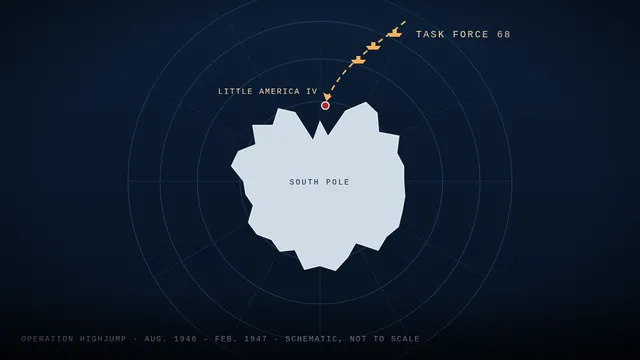
August 1946 – February 1947Operation Highjump sent 4,700 U.S. Navy personnel to Antarctica in 1946–47. What the expedition did, and why the famous Byrd “UFO” quote is a myth.
 Antarctica Files
Lake Vostok
1994–2012More than 400 lakes lie buried beneath Antarctic ice. Lake Vostok, under 3.7 km of ice, was reached in 2012. What scientists found and why it matters.
 Antarctica Files
ALH84001 Mars Meteorite
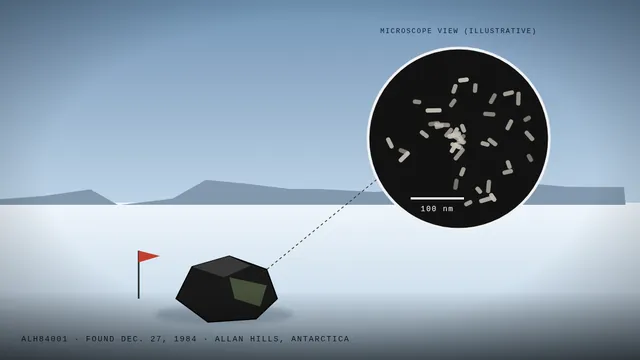
1984–1996In 1996 NASA scientists said a Mars meteorite found in Antarctica might hold fossil life. ALH84001 is still debated. The story and the science.
This archive is a historical and cultural reference compiled from public records and reporting. Including a case does not imply that it involved extraterrestrial visitors; where an official explanation exists it is stated, and contested claims are described as claims. Illustrations are original artwork, not photographs or archival footage. Ark Moon Chronicles and Above Below are works of fiction. Last reviewed October 5, 2026.