Antarctica Files
Operation Highjump, 1946–47: The Navy Goes South
It was the largest Antarctic expedition yet attempted, an exercise in cold-weather logistics that also photographed vast stretches of coastline. It is also the foundation of one of the most persistent Antarctic myths.
Case summary
- Date
- August 1946 – February 1947
- Location
- Antarctica (Ross Sea, Little America)
- Case file no.
- 1946-TF68
- Category
- Antarctica Files
- Official finding / status
- A real, well-documented naval expedition. Claims that it fought UFOs or a hidden base are unsupported.
What Operation Highjump was
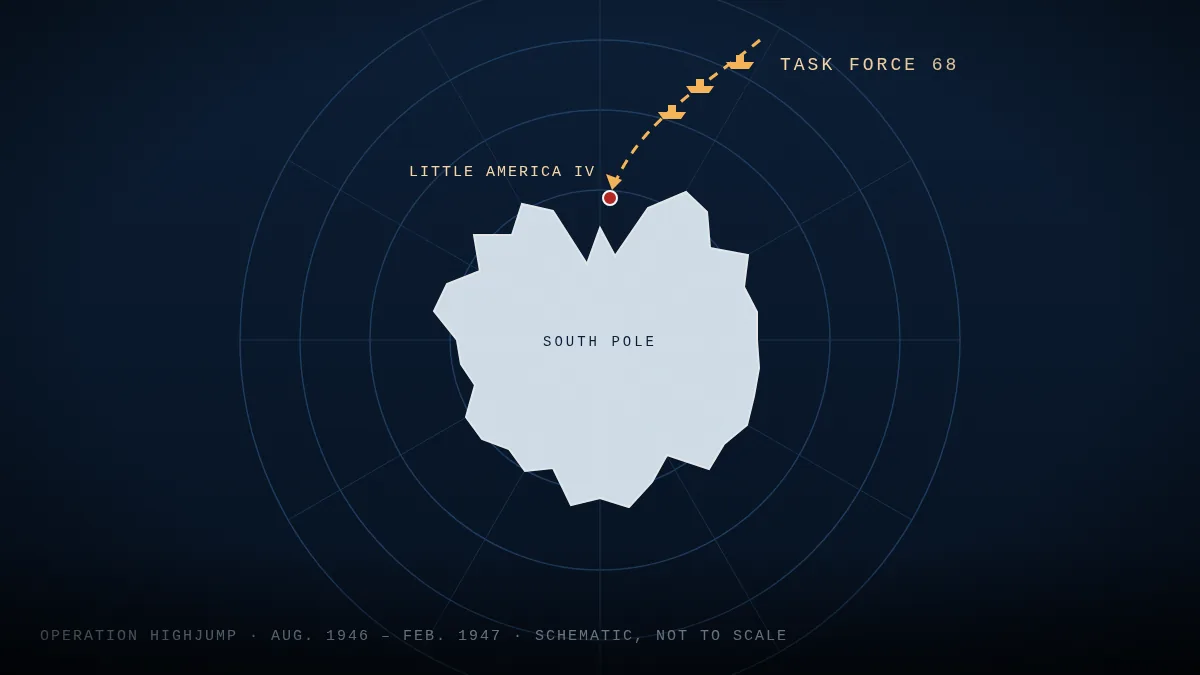
Officially the United States Navy Antarctic Developments Project 1946–1947, Operation Highjump was run as Task Force 68. Rear Admiral Richard H. Cruzen commanded the naval force, and Rear Admiral Richard E. Byrd, the celebrated polar explorer, led the scientific and research elements. The task force sailed in August 1946 and returned in late February 1947.
It included about 4,700 personnel, 13 ships, including an aircraft carrier, and dozens of aircraft. Its main purposes were to test ships, aircraft and new helicopters in extreme cold, to train naval personnel and to establish a base, Little America IV, while mapping and photographing the continent from the air. Three crew members died when a seaplane crashed on December 30, 1946.
The myth
A widely repeated claim holds that Highjump went south to attack a secret base, or that it was driven back by flying objects. The story is often traced to a March 5, 1947 interview Byrd gave to journalist Lee van Atta aboard the USS Mount Olympus, published in the Chilean newspaper El Mercurio.
The quotation circulated online is taken from a mistranslated or altered version. The original Spanish text reports Byrd as saying he did not want to alarm anyone, but that in a future war the United States could be attacked by aircraft capable of flying over the poles. That was a Cold War warning about long-range conventional aircraft and polar flight routes, not a statement about extraterrestrial craft.
What survives
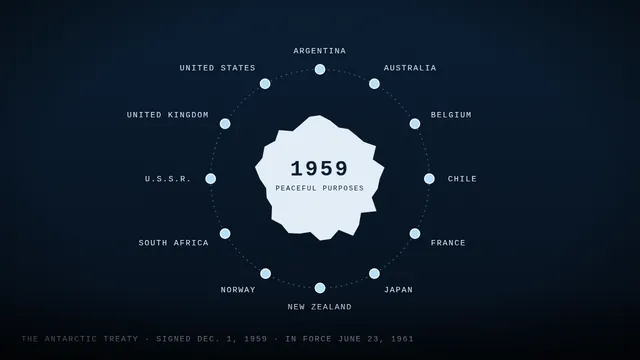
Highjump left a large body of aerial photographs and charts, a lasting template for polar logistics and a place in the story of what came after: the Navy’s Operation Deep Freeze and the demilitarised Antarctic of the 1959 treaty. There is no documentary evidence, in the Navy’s files or elsewhere, of a battle with alien craft, of Nazi bases or of any contact beneath the ice.
The myth survives because Antarctica is vast, remote and hard to inspect, which makes it a natural place to imagine secrets. That is also what makes it a natural setting for fiction.
Connection to Ark Moon Chronicles
The idea that something waits beneath Antarctic ice is the foundation of Above Below. In the story, the five realms lie under the ice, reached through hidden gates. Explore them in The Realm Atlas.
Frequently asked questions
What was Operation Highjump?
A 1946–47 U.S. Navy expedition to Antarctica, run as Task Force 68, involving about 4,700 personnel and 13 ships. It tested equipment in extreme cold and photographed large areas of coastline.
Did Admiral Byrd say UFOs attacked Operation Highjump?
No. The quote often cited comes from a March 5, 1947 El Mercurio interview, but the original Spanish reports Byrd warning that a future enemy could attack the U.S. with planes flying over the poles.
Is there a secret base in Antarctica?
There is no documentary evidence of one. The Antarctic Treaty allows observers from member nations to inspect any station, ship or aircraft on the continent at any time.
The story behind this case
This case is also a chapter of The Buried Files, our serialized story built on real, sourced reversals. Read Chapter 1, The Ice Door to see the real record beside a page from the fictional SILVER file.
Sources and further reading
Related case files
 Antarctica Files
Antarctic Treaty
1955–1961How Operation Deep Freeze and the 1959 Antarctic Treaty turned Antarctica into a demilitarised zone of science. What the treaty allows and what it bans.
 Antarctica Files
Lake Vostok
1994–2012More than 400 lakes lie buried beneath Antarctic ice. Lake Vostok, under 3.7 km of ice, was reached in 2012. What scientists found and why it matters.
 Antarctica Files
ANITA Radio Pulses
2006–2018 (published 2016, 2018)NASA’s ANITA balloon detected radio pulses that seemed to rise from beneath the Antarctic ice, defying known physics. What scientists know so far.
This archive is a historical and cultural reference compiled from public records and reporting. Including a case does not imply that it involved extraterrestrial visitors; where an official explanation exists it is stated, and contested claims are described as claims. Illustrations are original artwork, not photographs or archival footage. Ark Moon Chronicles and Above Below are works of fiction. Last reviewed October 5, 2026.