Antarctica Files
ALH84001: The Martian Rock Found in Antarctica
Antarctica is the best place on Earth to find meteorites. In 1984 a team found a rock that came from Mars, and twelve years later NASA suggested it might contain the traces of ancient life.
Case summary
- Date
- 1984–1996
- Location
- Allan Hills, Antarctica
- Case file no.
- 1996-ALH
- Category
- Antarctica Files
- Official finding / status
- A genuine Martian meteorite. The 1996 claim of fossil life remains disputed; most researchers favour non-biological explanations.
The find
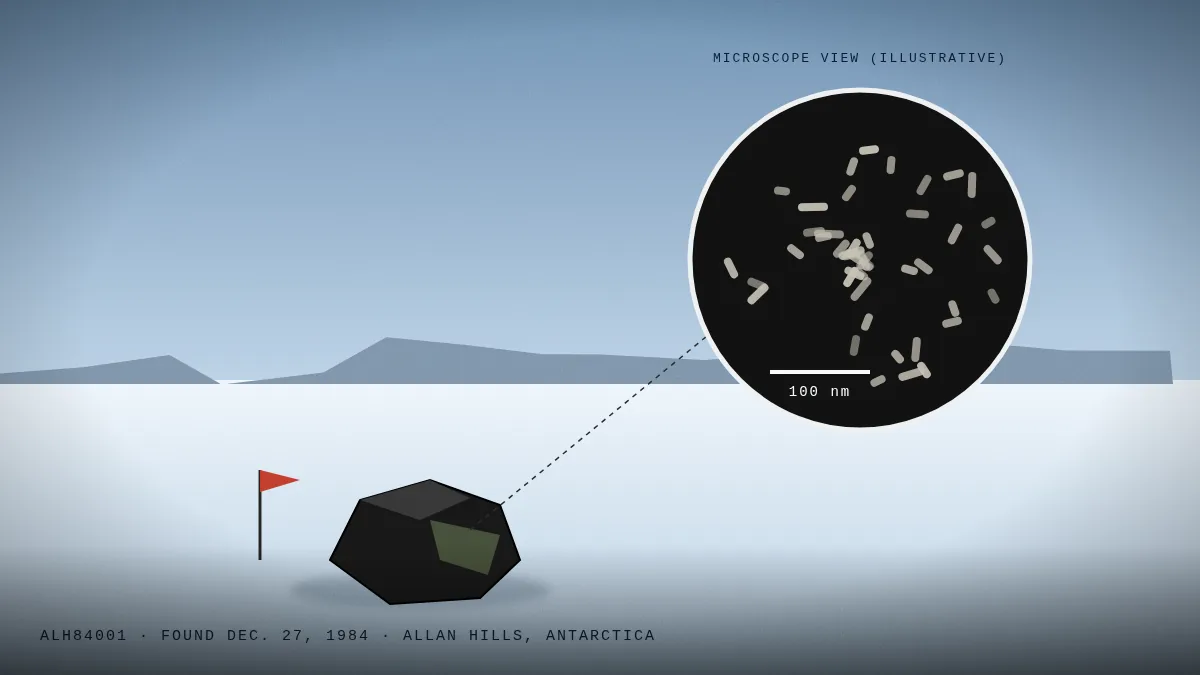
On December 27, 1984, a team from the Antarctic Search for Meteorites program found a greenish rock in the Allan Hills region of Antarctica. It was catalogued as Allan Hills 84001, or ALH84001. Years later it was identified as a piece of Mars, blasted off the planet by an ancient impact roughly 16 million years ago and fallen on the ice thousands of years ago.
Meteorites are easy to spot against the white ice, and the slow flow of the ice sheet concentrates them in certain places, which is why Antarctica has yielded a large share of the world’s meteorite collection.
The 1996 announcement
In August 1996 a NASA team led by David McKay announced that the meteorite contained features that might be evidence of past microbial life: carbonate globules, tiny magnetite crystals and structures resembling fossilised bacteria, 20 to 100 nanometres across, smaller than any known cellular life. The claim made headlines worldwide, and President Bill Clinton made a televised statement about it.
The aftermath
Other scientists argued that each of the lines of evidence could be explained by non-biological processes, and the structures were so small that many doubted they could be cells. The debate has continued for decades. ALH84001 is now a case study in how science handles an extraordinary claim: with scrutiny, repeated testing and no rush to conclude. It also helped launch the modern field of astrobiology and the long series of Mars missions that followed.
Connection to Ark Moon Chronicles
ALH84001 is a real object that fell from the sky and was preserved in Antarctic ice, which is not far from the idea that sets Above Below in motion. Begin with The Story.
Frequently asked questions
What is ALH84001?
A meteorite from Mars found in the Allan Hills region of Antarctica on December 27, 1984. It is about 4 billion years old.
Did NASA find life on Mars in a meteorite?
In 1996 a NASA-led team said the meteorite might contain evidence of past microbial life. Many scientists disagree and say the features can be explained without biology, so the claim remains contested.
Why are meteorites found in Antarctica?
Dark rocks are easy to see on white ice, and the slow movement of the ice sheet concentrates them in certain areas, so Antarctica yields a large share of the world’s meteorites.
Sources and further reading
Related case files
 Antarctica Files
Lake Vostok
1994–2012More than 400 lakes lie buried beneath Antarctic ice. Lake Vostok, under 3.7 km of ice, was reached in 2012. What scientists found and why it matters.
 Antarctica Files
ANITA Radio Pulses
2006–2018 (published 2016, 2018)NASA’s ANITA balloon detected radio pulses that seemed to rise from beneath the Antarctic ice, defying known physics. What scientists know so far.
 Antarctica Files
Antarctic Treaty
1955–1961How Operation Deep Freeze and the 1959 Antarctic Treaty turned Antarctica into a demilitarised zone of science. What the treaty allows and what it bans.
This archive is a historical and cultural reference compiled from public records and reporting. Including a case does not imply that it involved extraterrestrial visitors; where an official explanation exists it is stated, and contested claims are described as claims. Illustrations are original artwork, not photographs or archival footage. Ark Moon Chronicles and Above Below are works of fiction. Last reviewed October 5, 2026.