War.gov/UFO · September 18, 2026
PURSUE Release 06: Every Document Rated 1 to 5
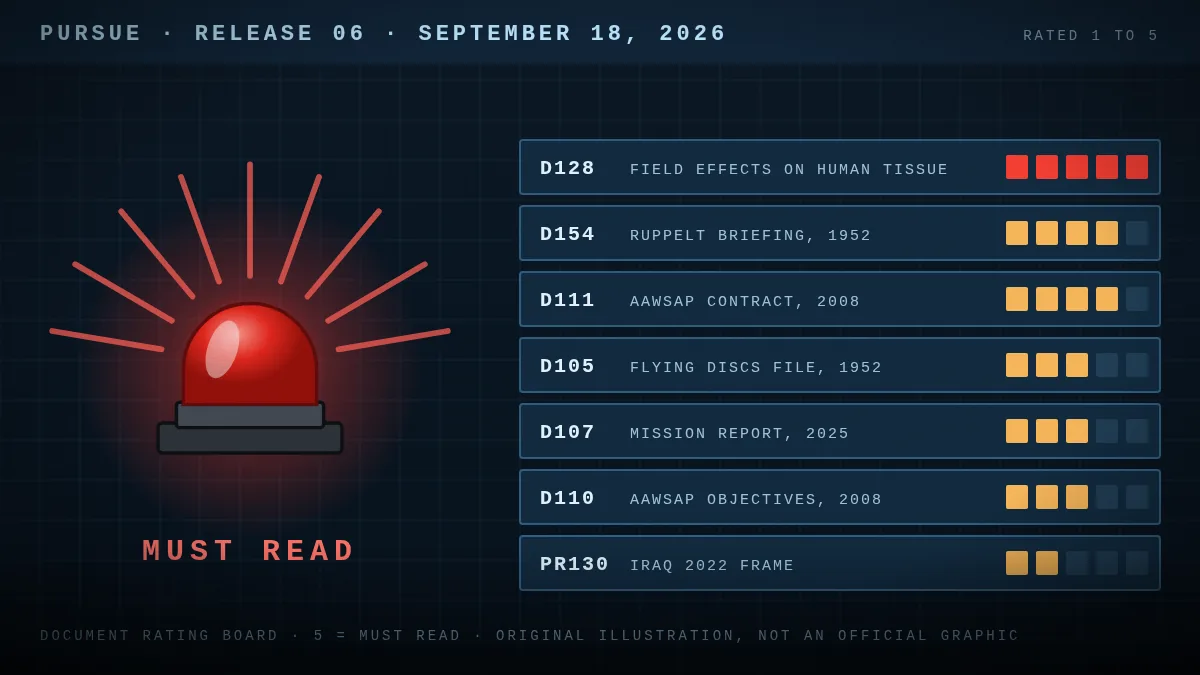
The Pentagon’s sixth batch of declassified UFO files is mostly the paperwork of one intelligence program, plus four recent mission reports and two 1952 documents. We read what we could, broke each document down to its facts and gave it two scores: how much it matters, and how strong its evidence is. A red warning light marks the one that is a must-read.
What stands out
- It is mostly the paperwork of one program. Release 06 centres on AAWSAP, a Defense Intelligence Agency effort that paid Bigelow Aerospace Advanced Space Studies about $21.9 million to forecast advanced aerospace threats. The contract, its objectives, its five modifications and 37 technical papers are all here.
- Only one of the 37 papers is about UFOs. Of the 22 papers we could read, D128 is the only one that discusses UFO cases. The rest are technology literature reviews on materials, propulsion, fusion, lasers and physics. The warp-drive and wormhole titles are theory, and the text we read says so.
- The recent military reports are thin. Four mission reports from 2022 and 2025 describe unidentified objects at 80 to 500 mph. None includes the sensor data needed to say what they were, and small drones are not ruled out. We rate each Evidence 2.
- The 1950s material shows institutional doubt. Ruppelt’s 1952 briefing and the Air Force headquarters file show the Air Force deciding in real time what to do about hundreds of reports it could not explain.
- Much of this was already public. The DIRDs reached the public through FOIA in 2022, and the Bigelow contract was reported years ago. What is new is that the Pentagon is now publishing them itself.
Scoreboard
Must read, and the two next in line
D128 · Defense Intelligence Reference Document · March 11, 2010
AAWSAP DIRD: Anomalous Acute and Subacute Field Effects on Human Biological Tissues
A Pentagon-funded paper that argues unexplained aerial systems may be injuring people, and that the pattern could be used to learn what they are. It is also a literature review built mostly on UFO books and catalogues, and it says so.
The facts
- Prepared by the Acquisition Support Division, Defense Warning Office, Defense Intelligence Agency, under the AAWSAP program. The author’s name is redacted.
- Core claim: there is a “sufficient” basis in incidents and accidents to hypothesise that “some advanced systems are already deployed, and opaque to full US understanding.”
- Argument: injuries seen in close encounters (burns, heating, nerve and brain effects) look like radio-frequency and electromagnetic injuries, so studying them could help “reverse engineer” whatever causes them.
- The one hard anchor is an ordinary accident: three antenna engineers exposed to roughly 785 MHz radio energy, cited from a 1997 journal. The paper compares their symptoms with the 1980 Cash-Landrum case and finds “no significant differences.”
- Most other cases come from UFO literature, including a 356-case catalogue (1873 to 1994) with 129 abductions, 77 vehicle electromagnetic effects and 75 cases of paralysis.
- It states plainly: “We make no attempt herein to validate any claims.”
Read with care
- Importance 5 means “read this,” not “this is proven.” The evidence is largely anecdote and secondhand reporting.
- Appendix C is an unfinished draft, and a footnote cites 240,000 peer-reviewed papers on radio-frequency hearing, a figure we could not verify and that looks far too high.
- The paper also discusses a man with paranoid schizophrenia whose claimed electromagnetic-weapon effects matched a once-secret 1998 Army intelligence document, a reminder that real programs can overlap with delusion.
D154 · Briefing transcript (19 pages) · March 1952
Transcript of a presentation by Captain Edward J. Ruppelt
The head of Project Blue Book, speaking candidly in 1952: roughly 800 to 900 cases on file, about a fifth of them from reliable witnesses, no conclusions possible, and an Air Force that does not want the answer to be Mars.
The facts
- About 800 to 900 cases were on file. Ruppelt put roughly 2 percent down to hoaxes or mental illness and about 20 percent as “very good reports offered by very reliable people… absolutely no conclusions can be drawn.”
- A second speaker split the file about 60 percent definitely identified, 20 percent possibly conventional and 20 percent unexplained, with green fireballs and lights the main unexplained groups.
- “Up till the present time, we’ve got no real proof that anything even exists.” And: “They may be from Mars, but if they are, we don’t want to think they are. We don’t want to think they’re all balloons.”
- Holloman cinetheodolites reportedly tracked five or six objects at about 150,000 feet and 3,500 mph. Ruppelt did not endorse it and said it could be a daylight meteor.
- Radar returns of 1,000 to 3,500 mph with no matching visual sighting were on file, with radar faults not ruled out. A Fort Monmouth T-33 radar case was debunked as a balloon plus flustered student operators.
- Lubbock Lights: he said five professors thought the photographs were fake, Hart gave a sworn statement and the Air Force was “up against a blank wall.” Mantell was explained as “Venus or a General Mills Skyhook.”
- The project was classified confidential. Planned fixes included diffraction-grating cameras and radar-scope cameras with Air Defense Command, plus a Battelle study.
Read with care
- The transcript is garbled in places. Kenneth Arnold is placed “out in Idaho” (his sighting was near Mount Rainier, Washington) and called “Lieutenant.”
- It is a spoken briefing, not a case investigation. It shows what the project believed in March 1952, not what it later concluded.
D111 · Contract · September 22, 2008
AAWSAP solicitation and original order
The paper trail for the program behind the DIRD series: who won the contract, how much it cost and what it had to deliver.
The facts
- Solicitation HHM402-08-R-0211, issued September 1, 2008; offers due September 10; contract HHM402-08-C-0072 awarded September 22, 2008 by the Defense Intelligence Agency’s Virginia Contracting Activity.
- Contractor: Bigelow Aerospace Advanced Space Studies, LLC, of Las Vegas, Nevada. Firm fixed price. Its proposal dated September 3, 2008 is incorporated by reference.
- Base year: $10,000,000, split into monthly status reports ($2.887 million), a project management plan for tasks 3.a.1 to 3.a.12 ($3.6 million), research reports ($2.1 million), a comprehensive integrated threat assessment ($240,000), travel and other costs.
- Block 26 shows a total award of $21,948,810, the same figure that modification P00002 later gives as the total obligated. This copy therefore appears to be conformed to later changes.
- Invoices were to be paid through the NSA Finance and Accounting Office at Fort Meade.
Read with care
- The text we could read is contract boilerplate. The statement of work itself is in D110.
Everything else we have read
D110 · Contract attachment · July 18, 2008
AAWSAP Statement of Objectives
The program’s mission statement: a Defense Warning Office forecast of foreign “breakthrough” aerospace technologies out to 2050. It lists lift, propulsion, control, power generation, spatial and temporal translation, materials, structure, signature reduction, human interface, human effects and armament, with a five-year contract, a TS/SCI facility and an integrated threat assessment as the final product. The text we read does not mention UAP or UFOs.
D112–D116 · Contract modifications · Sept 2009 to Sept 2010
AAWSAP contract modifications P00001 to P00005
P00001 (Sept 2, 2009) exercised the option year subject to funds, with option lines totalling $25.0 million. P00002 (Feb 2, 2010) funded $11,948,810 for it, noted “reduced funding” and its impact on deliverables, and raised total obligation to $21,948,810. P00003 (May 18, 2010) changed the contracting officer’s representative. P00004 (May 18, 2010) is nearly blank in the scan. P00005 (Sept 28, 2010) extended the period to December 21, 2010 at no cost.
D105 · Headquarters correspondence (170 pages) · Sept to Dec 1952
U.S. Air Force Flying Discs File, September to December 1952
The Air Force headquarters desk that handled flying-saucer business, seen at work during the 1952 wave: Navy photo-lab analysis requested for the Tremonton and Great Falls films, a background check on a Miami film witness, soil samples from Flatwoods, West Virginia, an FBI memo on a New Yorker article, and courtesy letters to magazines, senators and the public. A November 1950 object that fell into the sea off Okinawa was judged impractical to recover. Much of the file is form replies. Read: about 40 pages in full, and every page header.
D107 · Military mission report · Oct 28–29, 2025
Mission report, Middle East, 2025
A white round “orb,” solid, travelling up to about 500 mph at roughly 22,500 feet, seen for about nine minutes by a 11th Attack Squadron crew. No effects on people, unidentified. Marked SECRET//NOFORN and declassified June 2026. The form has UAP-specific fields for propulsion, intelligent control and advanced materials.
D108 · Military mission report · July 29–30, 2025
Mission report, Middle East, 2025
Six small spherical objects grouped together, changing direction frequently and at the same moment, at about 480 mph and 22,000 feet, with no response to the aircraft. A 65th Special Operations Squadron crew. The sensors did not interrogate them, which limits what can be said.
D106 · Military mission report · May 5, 2022
Mission report, Iraq, 2022
A crew on a 17-hour-50-minute mission over Iraq “periodically observed UAPs flying sporadically” at 80 to 180 mph, roughly 1 to 2 metres across, altitude not determined, “did not hinder the mission.” The sensor was full-motion video at 4.98 nautical miles. One field says “UAS” (drone), so small drones are not excluded. Declassified by a Central Command chief of staff.
D109 · Military mission report · May 4–5, 2022
Mission report, Middle East, 2022
A 20th Attack Squadron crew reports probable UAPs travelling south-west at about 80 to 180 mph over roughly 100 minutes, with dust storms degrading collection. The sensor reacquired them and they “did not hinder the mission.” Same speeds and size as D106, which points to a recurring pattern or a recurring ordinary cause.
D103 · Case file sheet · July 1952
Blue Book photo file: Tremonton film, Utah
One page of typed notes for the July 2, 1952 film by Navy photographer Delbert Newhouse: a group of objects “milling about,” no reference to judge size or speed, too small on the photograph for detail. The explanation line is too garbled to read reliably.
PR130 · Redacted infrared still · 2022
Unresolved UAP report, Iraq, 2022 (frame)
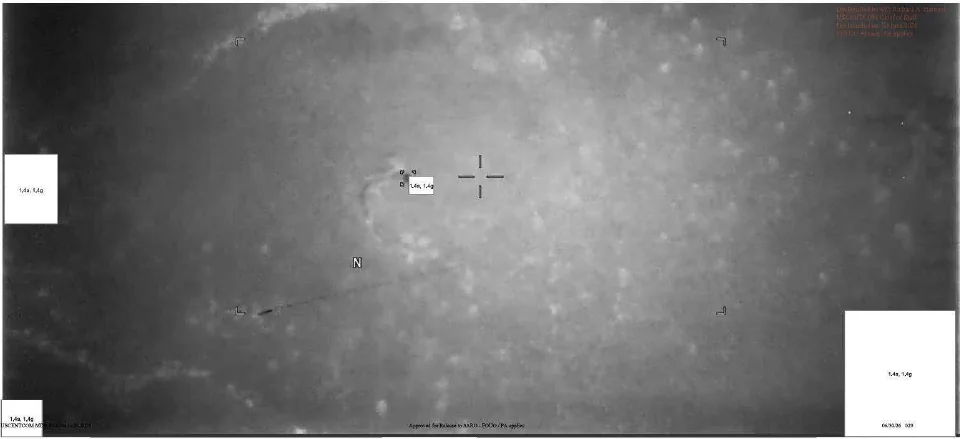
A single infrared frame stamped for release to AARO, with white redaction boxes (1.4a, 1.4g). A small dark object with a faint trail sits at lower left, and a second small feature sits beside a redaction box near the centre. Nothing else can be read from it.
PR131 · Redacted infrared still · 2022
Unresolved UAP report, Iraq, 2022 (frame)
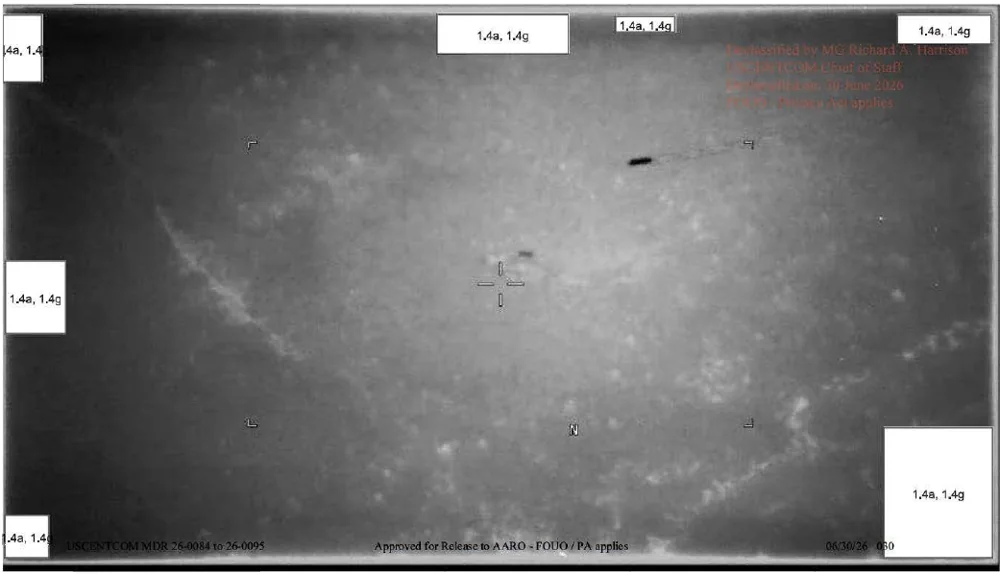
Another redacted infrared frame, declassified June 30, 2026. Two dark objects against textured ground, the larger near the upper right with a faint trailing streak, a smaller one near the crosshair. Without the metadata, nothing can be said about size, speed or distance.
Not yet rated
- D102: Blue Book file on the Tremonton film, Utah, 1952. A 122 MB scan that we could not read yet.
- D104: Final personnel record for Delbert C. Newhouse, U.S. Navy, 1957. A 172 MB scan that we could not read yet.
- Videos: About 15 clips in the release. We rate videos only from the release notes and the footage itself. Ratings will be added.
The 37 AAWSAP technical papers (D117 to D153)
These Defense Intelligence Reference Documents were produced in fiscal 2009 to 2011 for the Defense Warning Office. We could read the text of 22 of the 37. For the other 15, scanned images with no text layer, the rating is from the title alone. We searched the full text of every readable paper for “UFO,” “UAP,” “unidentified” and “extraterrestrial.” Only D128 discusses UFO cases. Evidence is N/A for all of them: they are reviews of theory and engineering, not reports of observations.
| No. | Title | Importance | What we read | Note |
|---|---|---|---|---|
| D117 | Metallic Glasses for Aerospace Applications | 1 out of 5 | Introduction and summary read | Materials review. “Extraterrestrial” appears once, about buildings on other worlds. |
| D118 | Aerospace Applications of Programmable Matter | 1 out of 5 | Introduction and summary read | Materials review. |
| D119 | Biomaterials | 1 out of 5 | Introduction and summary read | Medical materials review. |
| D120 | Materials for Advanced Aerospace Platforms | 1 out of 5 | Introduction and summary read | Launch vehicles, space vehicles and propulsion materials. |
| D121 | Pulsed High-Power Microwave Source Technology | 2 out of 5 | Title only (scanned PDF, not yet read) | Directed-energy topic that pairs thematically with D128. Scanned; not yet read. |
| D122 | Invisibility Cloaking: Theory and Experiments | 2 out of 5 | Introduction and summary read | Metamaterial cloaking review. |
| D123 | Positron Aerospace Propulsion | 1 out of 5 | Introduction and summary read | Antimatter propulsion anthology. |
| D124 | Space Access: Where We’ve Been and Where We Could Go | 1 out of 5 | Title only (scanned PDF, not yet read) | Scanned; not yet read. |
| D125 | Inertial Electrostatic Confinement Fusion | 1 out of 5 | Title only (scanned PDF, not yet read) | Scanned; not yet read. |
| D126 | Advanced Nuclear Propulsion for Manned Deep Space Missions | 1 out of 5 | Introduction and summary read | Fusion and nuclear rocket concepts. |
| D127 | An Introduction to the Statistical Drake Equation | 2 out of 5 | Title only (scanned PDF, not yet read) | About estimating alien civilisations. Scanned; not yet read. |
| D128 | Anomalous Acute and Subacute Field Effects on Human Biological Tissues | 5 out of 5 | Read in full | The only paper in the series that discusses UFO cases. See the feature above. |
| D129 | Metallic Spintronics | 1 out of 5 | Introduction and summary read | Electronics review. |
| D130 | Technological Approaches to Controlling External Devices | 2 out of 5 | Title only (scanned PDF, not yet read) | Scanned; not yet read. |
| D131 | The Role of Superconductors in Gravity Research | 2 out of 5 | Introduction and summary read | Gravity-wave and gravitoelectromagnetism history with a timeline. |
| D132 | Advanced Space Propulsion Based on Vacuum (Spacetime Metric) Engineering | 3 out of 5 | Read in full | Speculative physics. Says the energy needed is “many orders of magnitude” beyond today’s and that guessing a strategy is “premature.” Notes effects such as brightening, “blinking out” and hardened hulls that echo UAP reports without naming them. |
| D133 | Space Communication Implications of Quantum Entanglement and Nonlocality | 2 out of 5 | Introduction and summary read | Considers faster-than-light signalling, which would break accepted physics. |
| D134 | Maverick Inventor Versus Corporate Inventor | 1 out of 5 | Introduction and summary read | Where breakthroughs come from. |
| D135 | Antigravity for Aerospace Applications | 2 out of 5 | Title only (scanned PDF, not yet read) | Scanned; not yet read. |
| D136 | Biosensors and BioMEMS: A Survey of the Present Field | 1 out of 5 | Title only (scanned PDF, not yet read) | Scanned; not yet read. |
| D137 | State of the Art and Evolution of High-Energy Lasers | 1 out of 5 | Introduction and summary read | Laser weapons review. |
| D138 | Warp Drive, Dark Energy and the Manipulation of Extra Dimensions | 2 out of 5 | Introduction and summary read | Interstellar-travel physics review. |
| D139 | Traversable Wormholes, Stargates and Negative Energy | 2 out of 5 | Title only (scanned PDF, not yet read) | Scanned; not yet read. |
| D140 | High-Frequency Gravitational Wave Communications | 2 out of 5 | Title only (scanned PDF, not yet read) | Scanned; not yet read. |
| D141 | Metamaterials for Aerospace Applications | 1 out of 5 | Introduction and summary read | Super-lens and hyperlens review. |
| D142 | Concepts for Extracting Energy from the Quantum Vacuum | 2 out of 5 | Title only (scanned PDF, not yet read) | Scanned; not yet read. |
| D143 | Laser Lightcraft Nanosatellites | 1 out of 5 | Title only (scanned PDF, not yet read) | Scanned; not yet read. |
| D144 | Cockpits in the Era of Breakthrough Flight | 2 out of 5 | Title only (scanned PDF, not yet read) | Scanned; not yet read. |
| D145 | Aneutronic Fusion Propulsion I | 1 out of 5 | Title only (scanned PDF, not yet read) | Scanned; not yet read. |
| D146 | Aneutronic Fusion Propulsion II | 1 out of 5 | Introduction and summary read | Fusion propulsion review. |
| D147 | Ultracapacitors as Energy and Power Storage Devices | 1 out of 5 | Introduction and summary read | Energy storage review. |
| D148 | Detection and High-Resolution Tracking of Vehicles at Hypersonic Velocities | 2 out of 5 | Introduction and summary read | Recommends exploring detection of vehicles designed to be undetectable. |
| D149 | MHD Air-Breathing Propulsion and Power for Aerospace Applications | 1 out of 5 | Introduction and summary read | Plasma and magnetohydrodynamics review. |
| D150 | Quantum Computing and Utilizing Organic Molecules in Automation Technology | 1 out of 5 | Title only (scanned PDF, not yet read) | Scanned; not yet read. |
| D151 | Cognitive Limits on Simultaneous Control of Multiple Unmanned Spacecraft | 1 out of 5 | Introduction and summary read | Human-factors study. |
| D152 | Negative Mass Propulsion | 2 out of 5 | Introduction and summary read | Concludes the first route to negative mass is out of reach and the second means mining it from dark matter. |
| D153 | Quantum Tomography of Negative-Energy States in the Vacuum | 2 out of 5 | Title only (scanned PDF, not yet read) | Scanned; not yet read. |
How we rate
Every document gets two separate scores. They are different questions: a document can matter a great deal and prove very little.
Importance, 1 to 5
- 5 · Must read. Reserved for the few documents that stand out in a release. Flagged with the red warning light.
- 4 · Significant. Changes how a reader should understand a program, a case or an institution.
- 3 · Notable. Adds real information or a useful new detail.
- 2 · Context. Helpful background, but mostly routine or thin.
- 1 · Routine. Administrative, technical or unrelated to UFOs on its face.
Evidence strength, 1 to 5
How strongly the document itself supports the idea that something unexplained and physical was observed. Administrative papers, contracts and theory papers are marked N/A.
- 5. Fully analysed and independently corroborated.
- 4. Instrument data with analysis that rules out ordinary explanations.
- 3. Several sources or sensors, or an analysis that was done and recorded.
- 2. A witness or single-sensor report with no independent check.
- 1. A claim, a single frame or an image with no supporting data.
Limits
Scores are our judgment, not an official ranking. They are provisional until a whole release has been read, and we label each as based on the full text, part of it, an introduction or a title only. We have not verified claims inside the documents and we do not say any document proves extraterrestrial visitors. We checked, where we could, whether a document was already public, because “newly released” does not always mean “new.” The two largest scans (D102 and D104) and the videos are still to come. This page will be updated as they are read.
Frequently asked questions
What is PURSUE Release 06?
It is the sixth batch of declassified UFO and UAP records published by the Department of War at war.gov/ufo, released on September 18, 2026. It includes the 2008 to 2010 paperwork of the AAWSAP program, 37 technical papers, 1950s Air Force records, four recent mission reports and two redacted video frames.
What is AAWSAP?
The Advanced Aerospace Weapon System Applications Program was a Defense Intelligence Agency effort. The contract, awarded September 22, 2008 to Bigelow Aerospace Advanced Space Studies, forecast foreign aerospace technologies out to 2050. The agreement shows $21,948,810 obligated.
Which document is the red-light must-read?
D128, the DIA paper on anomalous field effects on human biological tissues. It argues that unexplained aerial systems may injure people, but it relies mainly on UFO literature and says it makes no attempt to validate any claims.
Do the warp drive and wormhole papers show the government has alien technology?
No. The ones we could read are literature reviews of speculative physics. One says the energy required is many orders of magnitude beyond what can be engineered today.
Were these documents already public?
Some were. The DIRDs were released under FOIA in March 2022, according to press reports, and the Bigelow contract was reported years ago. We note this on each rating where we could confirm it.
Sources and further reading
Related case files
 Modern Government Records
2026 Pentagon UFO Files
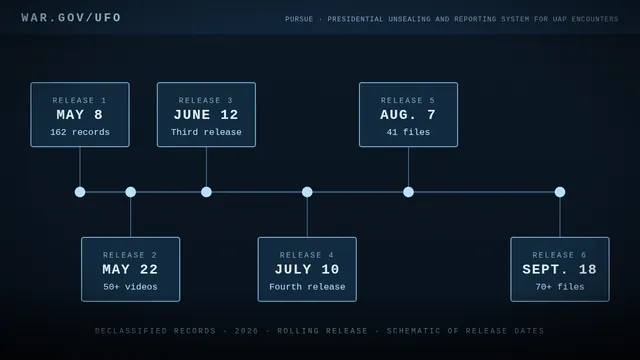
May 8 – September 18, 2026 (ongoing)The Pentagon has released six batches of declassified UFO files since May 2026 through PURSUE at war.gov/ufo. A guide to what each release contained.
 Project Blue Book Era
Project Blue Book
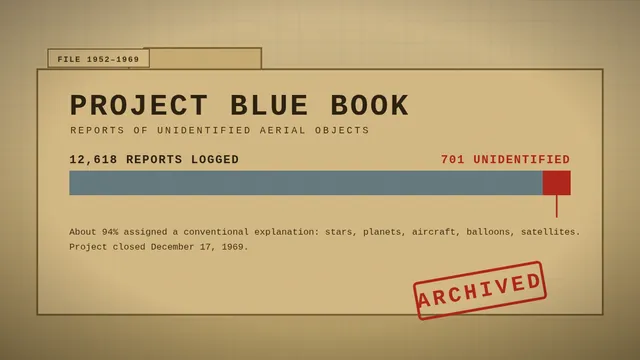
1947–1969How the U.S. Air Force investigated 12,618 UFO reports from 1947 to 1969, why 701 stayed unidentified, and how Project Blue Book came to an end.
 Project Blue Book Era
Lubbock Lights
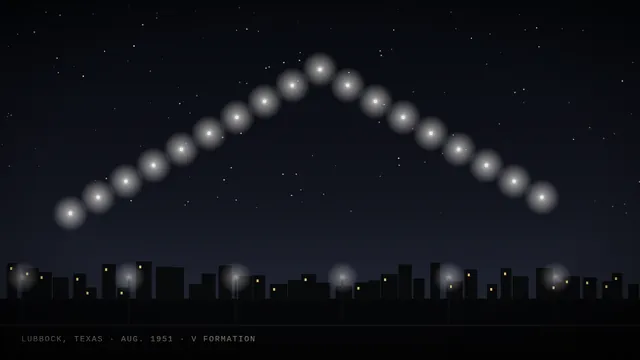
August 25–31, 1951In August 1951 Texas Tech professors and a student photographed V-shaped formations of lights over Lubbock. The Air Force suggested birds. Still debated.
This analysis is an independent reading of publicly released documents. Ratings are editorial judgments, not official findings, and including a document does not imply extraterrestrial involvement. Illustrations are original artwork; the two infrared frames are from the Department of War release. Last updated October 5, 2026. Ark Moon Chronicles and Above Below are works of fiction.