Project Blue Book Era
Project Blue Book: Inside the Air Force UFO Files
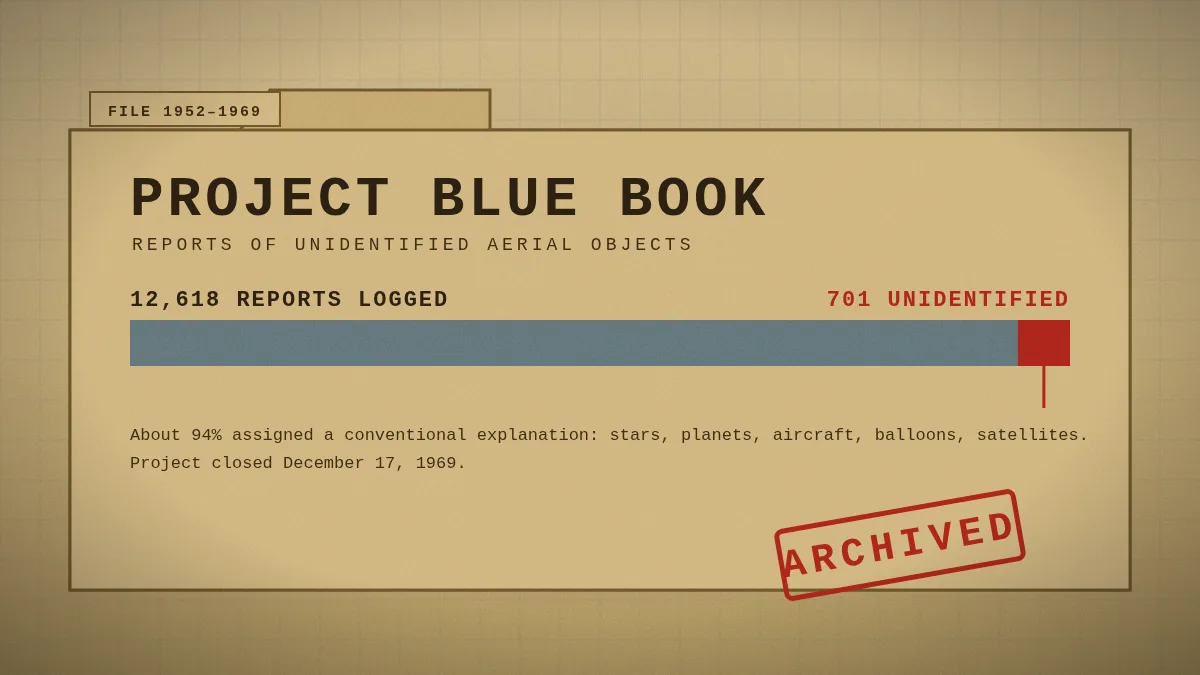
For seventeen years the U.S. Air Force kept the most extensive public record of unidentified flying objects ever assembled. Project Blue Book logged 12,618 reports, solved almost all of them to its own satisfaction, and left 701 in a folder marked “unidentified.”
Case summary
- Date
- 1947–1969
- Location
- Wright-Patterson Air Force Base, Ohio
- Case file no.
- ATIC-BB-1952
- Category
- Project Blue Book Era
- Official finding / status
- Closed December 17, 1969. No evidence of a threat to national security, of technology beyond current science, or of extraterrestrial vehicles.
What Project Blue Book was
Project Blue Book was the Air Force’s longest-running UFO investigation, run from Wright-Patterson Air Force Base near Dayton, Ohio. It inherited the work of two earlier efforts, Project Sign (1948) and Project Grudge (1949), and took the Blue Book name in 1952, the year of the largest wave of reports in its history.
Its job was narrow and practical: decide whether unidentified objects threatened national security, and whether any of them showed technology beyond what science understood at the time. Each report was logged, assigned to an investigator, and sorted into a category such as aircraft, balloon, astronomical body, hoax or “insufficient information.”
The numbers
Between 1947 and 1969 the Air Force recorded 12,618 sightings. Of those, 701 were never explained and remain listed as unidentified. That means roughly 94 percent of cases were assigned a conventional cause, usually stars, planets, meteors, aircraft, balloons or, after 1957, satellites and rocket debris.
The 701 are the reason the project is still argued over. Skeptics point out that many “unknowns” are simply cases with too little data. Researchers who take the phenomenon seriously point to the best-documented unknowns, such as the 1952 Washington radar cases and the 1964 Socorro landing, as evidence that something real was left unexplained.
The people behind the files
Captain Edward J. Ruppelt led the project in the early 1950s and later wrote The Report on Unidentified Flying Objects (1956), which popularised the phrase “UFO.” J. Allen Hynek, an astronomer at Northwestern University, served as the project’s scientific consultant. He began as a skeptic, grew uneasy about how some cases were handled, and later founded the Center for UFO Studies and proposed the “close encounter” classification still used today.
The CIA also took an interest. In January 1953 a scientific panel convened by the agency, known as the Robertson Panel, concluded that the reports posed no direct physical threat but recommended a public education effort to reduce interest in them.
Why Blue Book ended
Public confidence took a beating in March 1966 when Hynek suggested that swamp gas might explain dozens of sightings in Michigan. Congressional pressure led the Air Force to commission an outside review from physicist Edward U. Condon and a team at the University of Colorado. The Condon Report, delivered in 1969, concluded that further extensive study of UFOs was unlikely to advance science. A National Academy of Sciences review backed its methods.
On December 17, 1969, the Air Force announced that Project Blue Book was closed. Its stated conclusions were that no reported UFO had shown any indication of a threat to national security, that there was no evidence of technological developments beyond the range of modern scientific knowledge, and that there was no evidence that the unidentified sightings were extraterrestrial vehicles.
Where the files are now
The Blue Book records were transferred to the National Archives, where they have been digitised and opened to the public. They resurfaced in the news in 2024, when the Pentagon’s All-domain Anomaly Resolution Office re-examined them in its Historical Record Report, and again in 2026, when the sixth batch of PURSUE releases included an audio recording and transcript of a 1952 talk by Ruppelt on the Air Force’s early UFO data.
Connection to Ark Moon Chronicles
Ark Moon’s Codex borrows the case-file idea. Entries are written in-world and unlock in stages as the story reaches them, so the record grows as the reader does, a little like an archive being declassified one folder at a time.
Frequently asked questions
How many UFO reports did Project Blue Book investigate?
The Air Force recorded 12,618 reports between 1947 and 1969. Of those, 701 were listed as unidentified and never solved. The rest were assigned conventional explanations such as stars, planets, aircraft and balloons.
Why was Project Blue Book shut down?
The Air Force closed it on December 17, 1969, after the University of Colorado’s Condon Report concluded that further extensive study of UFOs was unlikely to advance science, and a National Academy of Sciences review supported the report’s methods.
Can the public read the Blue Book files?
Yes. The records are held by the U.S. National Archives and have been digitised and opened to the public. Newer government releases, including the 2026 PURSUE files, add related material.
The story behind this case
This case is also a chapter of The Buried Files, our serialized story built on real, sourced reversals. Read Chapter 7, The Bell to see the real record beside a page from the fictional SILVER file.
Sources and further reading
Related case files
 Project Blue Book Era
Washington, D.C.
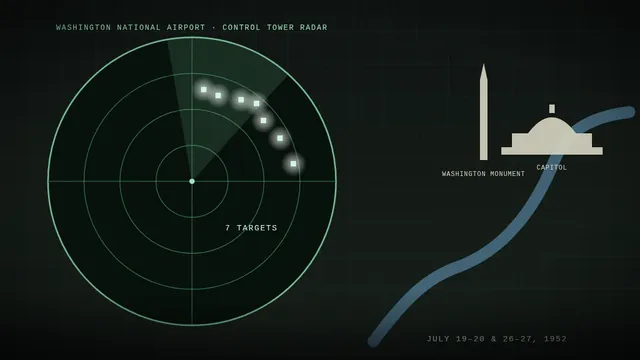
July 19–20 and 26–27, 1952In July 1952 unidentified radar targets appeared over Washington, D.C. on two weekends. Jets scrambled, and the Air Force held a huge press conference.
 Project Blue Book Era
Socorro Landing
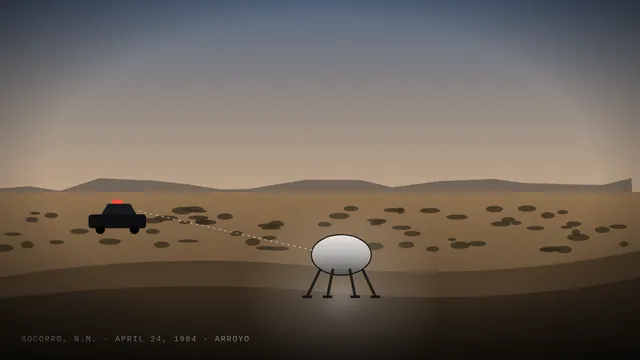
April 24, 1964Police officer Lonnie Zamora reported a landed craft near Socorro, New Mexico on April 24, 1964. Project Blue Book listed the case as unknown.
 Modern Government Records
AARO and Congress
2022–2026How the Pentagon’s AARO office was created, what its 2024 Historical Record Report found about Project Blue Book, and what Congress has heard since 2022.
 Modern Government Records
2026 Pentagon UFO Files
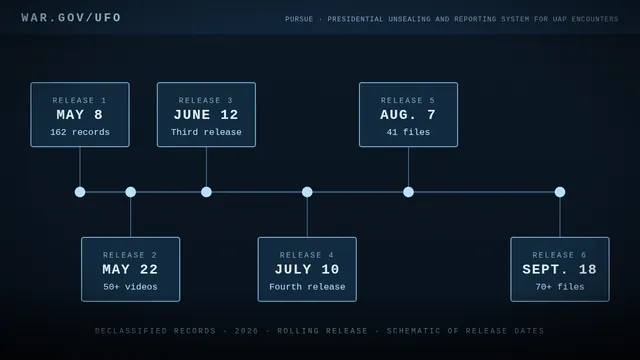
May 8 – September 18, 2026 (ongoing)The Pentagon has released six batches of declassified UFO files since May 2026 through PURSUE at war.gov/ufo. A guide to what each release contained.
This archive is a historical and cultural reference compiled from public records and reporting. Including a case does not imply that it involved extraterrestrial visitors; where an official explanation exists it is stated, and contested claims are described as claims. Illustrations are original artwork, not photographs or archival footage. Ark Moon Chronicles and Above Below are works of fiction. Last reviewed October 5, 2026.